Guardrails and Human-in-the-Loop for Business AI: Making LLMs Reliable in Production
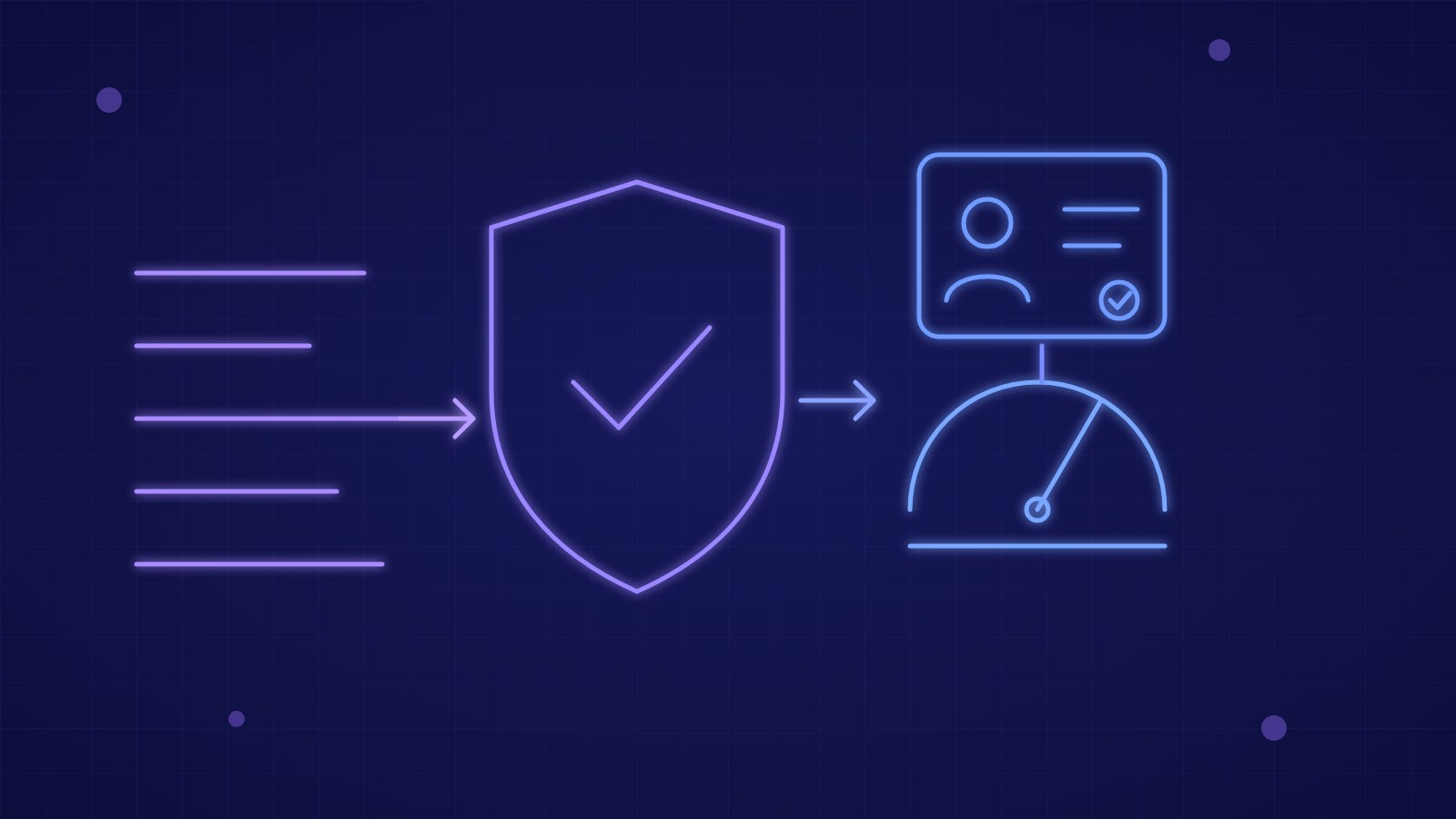
A guardrail is an automatic check that verifies a language model's inputs and outputs before they have any effect; human-in-the-loop (HITL) is the step where a person approves or corrects the decision when risk or uncertainty is too high. Together they let you run an LLM in production without trusting it with unverified decisions: AI handles the 70-90% of simple cases, people focus on the doubtful ones.
What Guardrails Are and Why You Need Them
An LLM produces plausible answers, not guaranteed ones. It can invent an amount, cite a clause that does not exist or follow an instruction hidden in a document. Guardrails are the deterministic controls around the model: they restrict what can go in, what can come out and which actions it can trigger.
There are three levels: input guardrails (personal data filtering, length limits, prompt injection attempts), output guardrails (format, allowed values, consistency with source data) and action guardrails (least-privilege permissions, amount limits, read-only operations until approval).
Validating LLM Output
Validation starts with shape: enforce a JSON schema and reject any response that does not comply. Then check substance with business rules: an invoice total must equal the sum of its lines, a date must come after the order date, a customer code must exist in the CRM.
For text answers, use grounding checks: every claim must be traceable to a retrieved document, otherwise the answer is discarded or flagged as unverified. A second model as verifier (LLM-as-judge) is useful but must be measured on a test set, since it introduces errors of its own.
Confidence Thresholds: When AI Decides and When a Person Does
A confidence threshold turns uncertainty into an operating rule. A typical example: above 0.90 the action is automatic, between 0.70 and 0.90 it goes to human review, below 0.70 it is rejected or routed to an operator. Thresholds are not chosen by gut feeling: calibrate them on a real sample of at least 200-300 labeled cases, measuring how many errors slip through at each level.
Models do not always return a reliable probability. In practice you combine signals: classifier score, agreement across multiple runs, business rule results, completeness of extracted fields. The risk of the action matters as much as confidence: answering an FAQ and issuing a refund need different thresholds.
Designing HITL Without Creating Bottlenecks
A poorly designed HITL moves the work from people to the approval queue. Show the reviewer the AI proposal, the sources and the reason the case was flagged, with quick actions: approve, edit, reject. Average review time should stay in the range of tens of seconds, not minutes.
Reviewer corrections are an asset: each edit is a labeled example that feeds regression tests, prompt improvements and threshold recalibration. Over time the share of automatic cases can rise in a controlled way, for example from 60% to 85%, without increasing errors.
- Classify each use case by risk level before deciding how much autonomy AI gets.
- Enforce schema and business rules on output and discard what fails them.
- Calibrate confidence thresholds on at least 200-300 real labeled cases.
- Give reviewers the proposal, sources and flag reason with one-click actions.
- Define escalation, SLAs and a degraded mode for cases AI must not handle.
- Record input, versions, output, validation and final decision in a protected audit log.
Escalation and Exception Handling
You need a clear path for what AI must not handle: legal complaints, amounts above a limit, strategic customers, requests involving sensitive data. These categories should go to an owner with a defined response time (SLA), not sit in a generic queue.
Failures must be planned for too: if the provider is down or validation keeps failing, the system switches to a degraded mode, such as a manual form, and raises an incident. An n8n workflow can implement these steps with approval nodes, timeouts and notifications.
Audit Logs and Compliance
Every AI-assisted decision should leave a trace: input (minimized or pseudonymized), model and prompt version, raw output, validation result, confidence, reviewer if any, and the final decision with timestamp. This log lets you explain an error, answer a complaint and demonstrate the human oversight the AI Act requires for high-risk systems.
The log must be protected like any sensitive data: role-based access, limited retention consistent with GDPR, guaranteed integrity. The same data feeds governance metrics: automation rate, human override rate, review time and escaped errors.
Key takeaway: guardrails do not slow AI down, they make it usable: automatic validation, calibrated thresholds, targeted human review and audit logs let you raise automation only where the data shows it is safe.