Error Handling and Observability in n8n Workflows: Best Practices for Reliable Automation
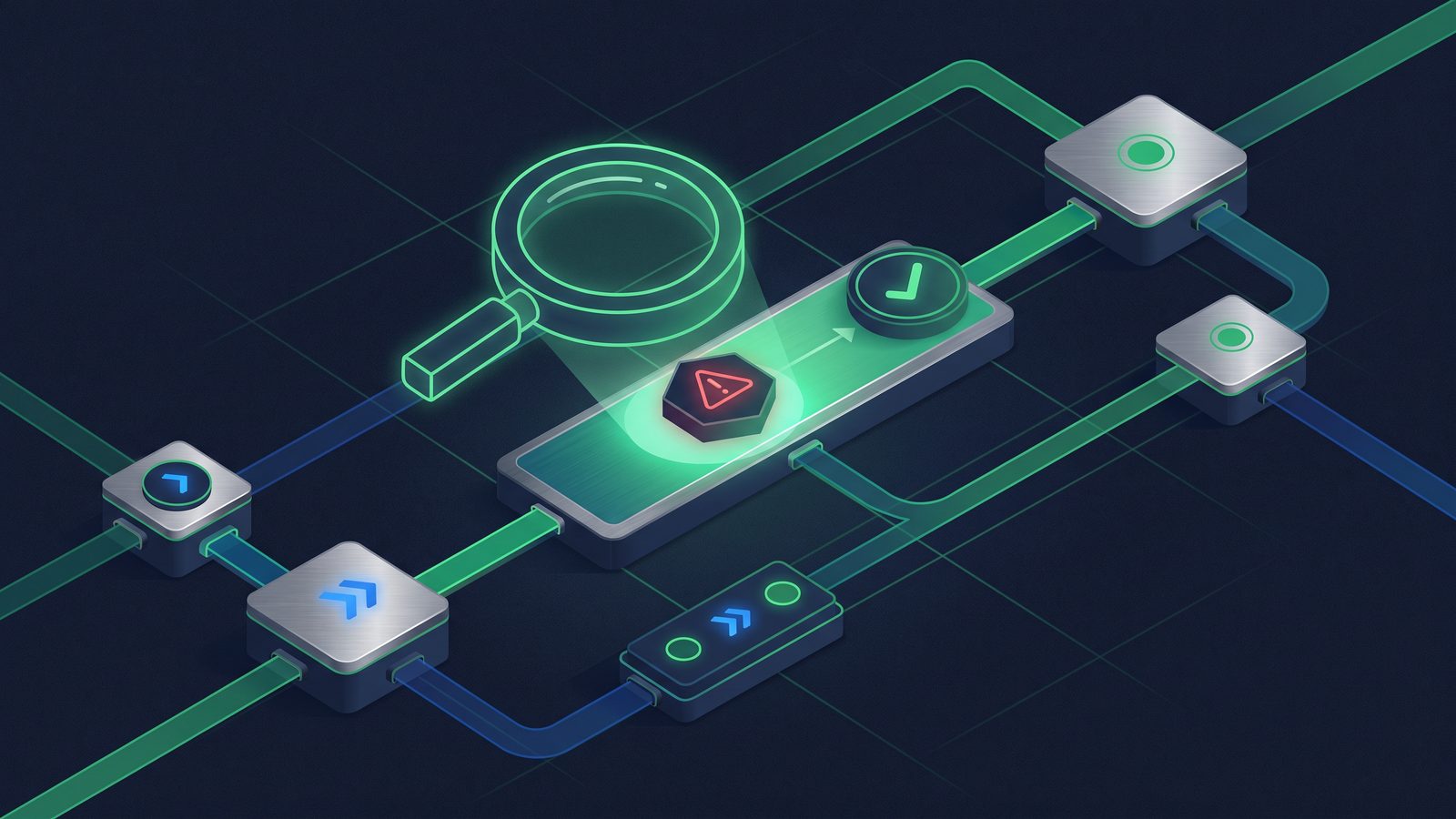
The most expensive problem with an n8n automation is almost never the workflow that never works: it's the workflow that works for months and then fails silently, until a customer calls asking why they never received their invoice. As n8n automations move from isolated experiments to infrastructure governing critical business processes, error handling and observability stop being an optional technical detail and become the difference between a reliable automation and a hidden operational risk.
Why Workflows Fail Silently
By default, an n8n workflow that hits an error in a node simply stops: the failed execution is logged, but without explicit configuration no one is actively notified. If the workflow is triggered rarely, a failure can go unnoticed for days or weeks, especially when the person who built the automation isn't the one who depends on it operationally.
Error Trigger Workflow: The First Line of Defense
n8n lets you attach a dedicated Error Workflow to every workflow, triggered automatically whenever the main workflow fails, receiving the error details as input. Configuring an Error Workflow that sends a notification to Slack, Teams or email turns a silent failure into an immediate, actionable alert — ideally with a direct link to the failed execution.
Automatic Retries: When to Use Them and When Not To
Many n8n nodes support automatic retry on error, useful for transient failures like a network timeout or a temporary API rate limit. It's important to distinguish transient errors (retry) from permanent ones like missing data or an invalid format, where retrying automatically only delays the alert that should reach a human.
Proactive Monitoring: Don't Wait for Someone to Report the Problem
For automations governing critical processes, it pays to set up proactive volume monitoring: if a workflow that normally processes 50-100 executions a day suddenly logs zero, that's almost certainly a signal of an upstream problem, even without an explicit error. A periodic check comparing current execution volume against the historical average, with an alert on significant anomalies, catches this category of problem before it causes real impact.
- Attach a dedicated Error Workflow to every critical automation, with a notification and a direct link to the failed execution.
- Configure automatic retries only for transient errors, not for data or logic errors.
- Validate incoming data right after the trigger, with clear error messages on non-conforming data.
- Add structured logging with a unique execution identifier for workflows spanning multiple systems.
- Monitor execution volumes over time to catch anomalous drops even without explicit errors.
The bottom line: an n8n automation without error handling and observability isn't reliable automation — it's an operational risk disguised as efficiency. The investment in error handling and monitoring is what turns a fragile experiment into business infrastructure you can actually count on.